

















Insights / Learning & Development
The Human Factor in a High-Speed World: Why Behavioural Training Matters More Than Ever
Technology is accelerating work. Human behaviour has to keep up. Why resilience, empathy, judgement and adaptability are becoming business-critical in the age of AI.
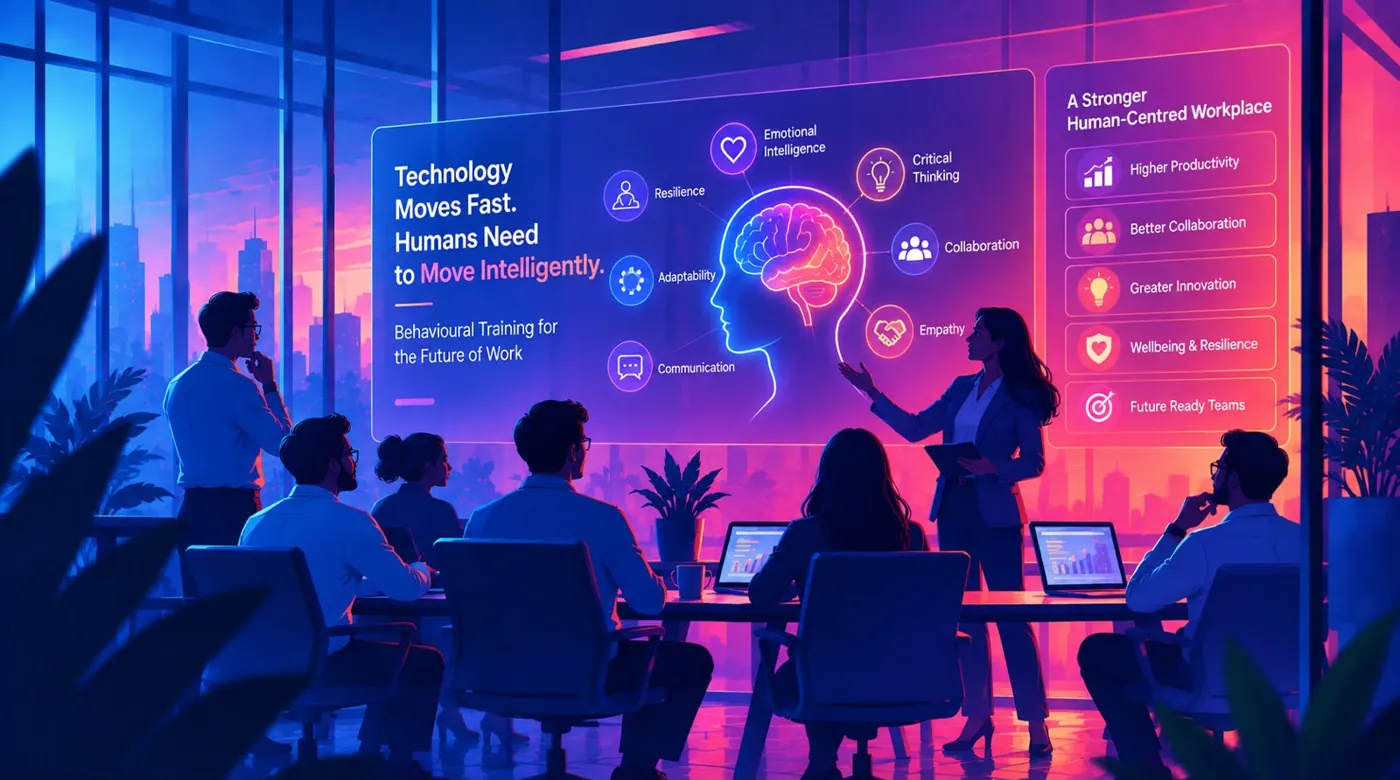
AI can generate ideas in seconds. Automation runs processes without human input. Teams collaborate across continents, and information is available almost instantly. Yet there's an interesting contradiction: the faster technology becomes, the more important human behaviour becomes.
The real challenge for organisations isn't whether employees can learn another tool. It's whether people can keep thinking clearly, communicating well, handling ambiguity, collaborating with empathy and staying resilient while everything around them keeps changing.
Are people becoming more fragile?
Not weaker, but under more pressure. Modern work expects people to respond immediately, multitask constantly, learn new tools, adapt to shifting priorities, work across time zones and stay productive through constant change. Technology has removed friction from work, but it has also raised the speed at which people are expected to operate.
The human adaptation gap
A company can roll out a new AI system in weeks. Building the confidence and habits to use it well takes much longer. Technology changes at implementation speed; behaviour changes through repetition, experience and reinforcement. When organisations focus only on technology adoption, the result is often new systems, old behaviours and surprisingly little transformation.
Work has become an attention economy
Emails, chat messages, meetings, dashboards, AI outputs, alerts and customer requests arrive all day. The problem isn't only the volume of information. It's the expectation to be constantly responsive to it. When attention is fragmented, people tend to:
- React instead of reflect
- Optimise for speed over quality
- Avoid difficult conversations
- Misread written messages
- Decide with incomplete context
- Lose patience with colleagues
Technology doesn't cause these behaviours, but a high-speed environment can amplify them.
The lost art of the pause
One of the most underrated workplace skills is the ability to pause: before responding, judging, escalating, sending that email or assuming someone's intent. Behavioural training helps people tell the difference between:
Urgent
vs important
Reaction
vs response
Information
vs insight
Speed
vs effectiveness
AI makes behavioural intelligence more important
AI can write, summarise, analyse, build presentations and support decisions. But when it offers ten possible answers, someone still has to choose the right one. When it drafts a message, someone has to understand the audience. And when teams work alongside AI agents, people still need to define responsibility, accountability and trust. The future workplace needs technical intelligence plus behavioural intelligence.
The skills machines can't fully replace
Listening
Understanding what someone actually means, not just hearing it
Empathy
Seeing other perspectives without having to agree
Adaptability
Changing behaviour when circumstances change
Collaboration
Working well with different people and priorities
Conflict resolution
Disagreeing without it turning destructive
Critical thinking
Questioning assumptions and information
Communication
Making complex ideas clear and actionable
Judgement
Knowing when to trust a system and when to question it
Why it's no longer a "soft skill"
Picture a team of technically brilliant people with weak behavioural foundations: poor collaboration, communication breakdowns, leadership friction, resistance to change, dysfunctional meetings and siloed teams. No software platform fixes that. It takes behavioural change, which is why behavioural training should be treated as business infrastructure, not an optional extra.
Behavioural training for the AI workplace
Communication, leadership, time management and team building still matter, but modern programmes need to go further:
- Digital communication. Communicating well across email, chat, video calls, presentations and AI-assisted tools.
- Resilience. Staying effective when priorities keep changing.
- Adaptability. Moving from "this is how we've always done it" to "what does this situation need now?"
- Critical thinking with AI. Evaluating AI-generated information instead of accepting it automatically.
- Empathy in digital work. Reading tone, context and emotion through a screen.
- Conflict management. Disagreeing constructively without making it personal.
- Leadership under uncertainty. Giving teams clarity even without all the answers.
Training has to be experiential
Knowing that active listening matters doesn't mean someone will practise it in a tense meeting. One-off workshops rarely change behaviour on their own. Lasting change follows a cycle:
AwarenessPracticeFeedbackReinforcementHabit
That's why effective programmes use simulations, role-play, real workplace scenarios, peer feedback, coaching, microlearning and follow-up, so people behave differently when it actually counts.
From training events to behavioural architecture
Behaviour isn't created by training alone. Telling people to collaborate is one thing; designing incentives, workflows and leadership habits that reward collaboration is another. Training builds awareness and capability. Leadership, culture, recognition, feedback and performance systems decide whether that capability becomes habit.
The question organisations should ask
Not just "Are our employees ready for AI?" but "Are our people behaviourally ready for the speed of change AI will create?" Can they adapt, learn and unlearn? Can they disagree, collaborate and manage uncertainty? These are no longer HR questions. They're strategic business questions.